Lab 6: Recursion and Tree Recursion
Due at 11:59:59 pm on 3/5/2024.
⚠️ This content is archived as of March 2026 and is retained exclusively for reference. Find the most current offering here.
Starter Files
Download lab06.zip. Inside the archive, you will find starter files for the questions in this lab, along with a copy of the OK autograder.
Recursion
Question 1: AB Plus C
Implement ab_plus_c, a function that takes arguments a, b, and
c and computes a * b + c. You can assume a and b are both nonnegative
integers. However, you can't use the * operator. Try recursion!
def ab_plus_c(a, b, c):
    """Computes a * b + c.

    >>> ab_plus_c(2, 4, 3)  # 2 * 4 + 3
    11
    >>> ab_plus_c(0, 3, 2)  # 0 * 3 + 2
    2
    >>> ab_plus_c(3, 0, 2)  # 3 * 0 + 2
    2
    """
    "*** YOUR CODE HERE ***"
    if b == 0:
        return c
return a + ab_plus_c(a, b - 1, c)Use OK to test your code:
python3 ok -q ab_plus_cQuestion 2: Filter
Write the recursive version of the function filter which returns a list and takes in
f- a one-argument function that returnsTrueif the passed in argument should be included in the resulting list orFalseotherwiseseq- a list of values
Note that this is different from the built in filter function we learned previously, which returns a filter object, not a list.
def filter(f, seq):
    """Filter a sequence to only contain values allowed by filter.

    >>> def is_even(x):
    ...     return x % 2 == 0
    >>> def divisible_by5(x):
    ...     return x % 5 == 0
    >>> filter(is_even, [1,2,3,4])
    [2, 4]
    >>> filter(divisible_by5, [1, 4, 9, 16, 25, 100])
    [25, 100]
    >>> filter(is_even, [1])
    []
    >>> filter(is_even, [2])
    [2]
    >>> filter(is_even, [])
    []
    """
    "*** YOUR CODE HERE ***"

    if seq == []:
        return seq
    if f(seq[0]):
        return [seq[0]] + filter(f, seq[1:])
return filter(f, seq[1:])Use OK to test your code:
python3 ok -q filterQuestion 3: Decimal
Write the recursive version of the function decimal which takes in an integer n and returns a list of its digits, the decimal representation of n. See the doctests to handle the case where n < 0.
def decimal(n):
    """Return a list representing the decimal representation of a number.

    >>> decimal(0)
    [0]
    >>> decimal(2)
    [2]
    >>> decimal(-8)
    ['-', 8]
    >>> decimal(-136)
    ['-', 1, 3, 6]
    >>> decimal(55055)
    [5, 5, 0, 5, 5]
    """
    "*** YOUR CODE HERE ***"
    if n < 0:
        return ['-'] + decimal(-1 * n)
    elif n < 10:
        return [n]
    else:
return decimal(n // 10) + [n % 10]Use OK to test your code:
python3 ok -q decimalQuestion 4: Insect Combinatorics
Consider an insect in an M by N grid. The insect starts at the
bottom left corner, (0, 0), and wants to end up at the top right
corner, (M-1, N-1). The insect is only capable of moving right or
up. Write a function paths that takes a grid length and width
and returns the number of different paths the insect can take from the
start to the goal. (There is a closed-form solution to this problem,
but try to answer it procedurally using recursion.)
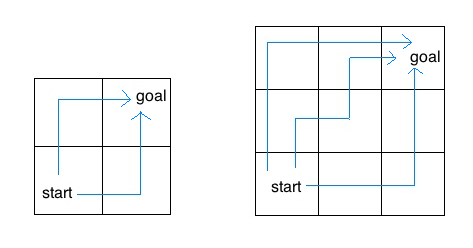
For example, the 2 by 2 grid has a total of two ways for the insect to move from the start to the goal. For the 3 by 3 grid, the insect has 6 different paths (only 3 are shown above). Note that this problem uses tree recursion.
def paths(m, n):
    """Return the number of paths from one corner of an
    M by N grid to the opposite corner.

    >>> paths(2, 2)
    2
    >>> paths(5, 7)
    210
    >>> paths(117, 1)
    1
    >>> paths(1, 157)
    1
    """
    "*** YOUR CODE HERE ***"
    if m == 0 or n == 0:
        return 0
    if m == 1 and n == 1:
        return 1
return paths(m - 1, n) + paths(m, n - 1)Use OK to test your code:
python3 ok -q pathsSubmission
When you are done, submit your file to Gradescope. You only need to upload the following files:
lab06.py